
“Simply by chanting the holy name of Kṛṣṇa, one can obtain freedom from material existence. Indeed, simply by chanting the Hare Kṛṣṇa mantra, one will be able to see the lotus feet of the Lord.”
Founder-Ācārya of ISKCON
Śrīla
Prabhupāda
1896 — 1977
Early Life
Born in the Holy City of Calcutta
Abhay Charanaravinda De was born on the auspicious day of Nandotsava — the day after Janmāṣṭamī — in Calcutta, India, on September 1, 1896. From his earliest years, the signs of a great Vaiṣṇava were evident. His father, Gour Mohan De, was a devoted Vaiṣṇava who prayed that his son would one day become a servant of Rādhārāṇī and grow up to spread the chanting of the holy names around the world.
As a child, Abhay organised small Ratha Yātrā festivals in his neighbourhood, pulling a small cart of Lord Jagannātha just as he had seen the great procession at Purī. He was steeped in devotional culture from birth — a gift he would later carry to every corner of the globe.
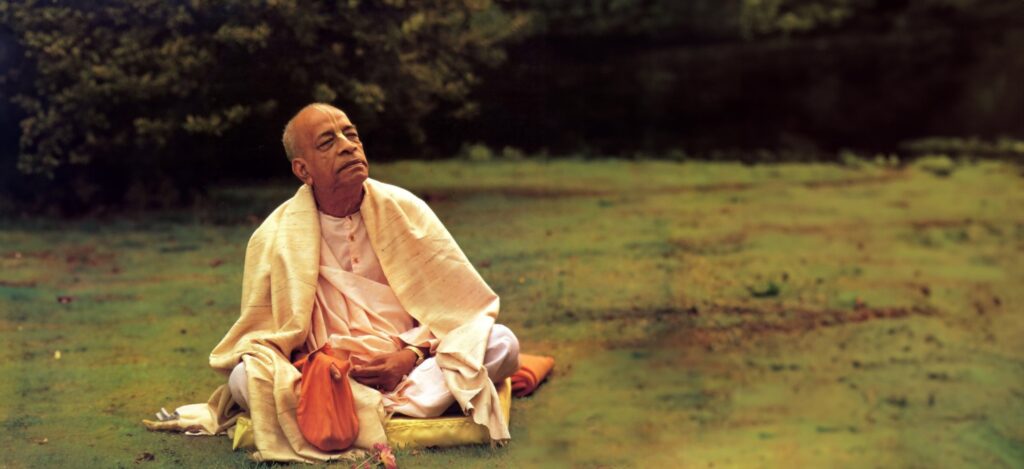
He pursued his education at Scottish Church College in Calcutta, where he met his spiritual master, Śrīla Bhaktisiddhānta Sarasvatī Ṭhākura, at the age of 26 in 1922. This encounter changed the course of his life. Bhaktisiddhānta immediately recognised the young man’s potential and urged him to spread the teachings of Lord Caitanya in the English language to the Western world.
Discipleship
Initiated by Śrīla Bhaktisiddhānta Sarasvatī
In 1933, Abhay Charanaravinda formally received initiation from Śrīla Bhaktisiddhānta Sarasvatī Ṭhākura and took the name Abhay Charanaravinda Dāsa. His spiritual master’s instruction was unambiguous: go to the English-speaking world and preach the message of Lord Caitanya. This instruction became the defining mission of Prabhupāda’s life.
For the next three decades, Prabhupāda remained in India — managing a family, running a pharmaceutical business, and all the while writing, translating, and contemplating how he might fulfil his guru’s instruction. In 1950, he took vānaprastha (retired life) and devoted himself increasingly to study and writing. In 1959 he received sannyāsa, the renounced order, taking the name A.C. Bhaktivedanta Swami.
“My Guru Mahārāja told me that I should preach in English. That was his order. So I tried to follow, and now — by his grace — the whole world is chanting Hare Kṛṣṇa.”
— Śrīla Prabhupāda
1965 — The Voyage West
A 69-Year-Old Swami Sails to America
In August 1965, carrying forty rupees, a small supply of dry cereal, and a trunk of his translated scriptures, A.C. Bhaktivedanta Swami boarded the cargo ship Jaladuta in Calcutta, bound for New York. During the voyage, he suffered two heart attacks. Yet he continued writing in his diary, resolved to carry out his mission.
He arrived in New York City on September 17, 1965. For almost a year he struggled, living on the charity of sympathetic Indians and sleeping on the floor of friends’ apartments. Then, in the summer of 1966, something extraordinary happened.
In Tompkins Square Park in the Lower East Side of Manhattan, Prabhupāda began holding outdoor kirtanas — chanting the Hare Kṛṣṇa mantra with a small group of young Americans. The counterculture youth of New York were electrified. Within months he had established the International Society for Krishna Consciousness — ISKCON — on July 11, 1966.
1966 — Present
Founding ISKCON — A Global Spiritual Family
From that single storefront on Second Avenue in New York, Prabhupāda’s movement spread with astonishing speed. Within just twelve years — between 1966 and 1977 — he established over 108 temples on every inhabited continent, initiated over 10,000 disciples, and oversaw a farm community program, a restaurant chain (Govinda’s), and the world’s largest vegetarian food distribution program (Food for Life).
1966
ISKCON Founded, New York City
The International Society for Krishna Consciousness established on July 11 with seven inaugural members.
1967
San Francisco — Haight-Ashbury
The Summer of Love kirtan in Haight-Ashbury introduced thousands of young Americans to chanting. Prabhupāda befriended Allen Ginsberg, who became a vocal supporter of the mantra.
1968
Expansion to Europe and Beyond
First ISKCON temples opened in London, Hamburg and Montreal. The Beatles assisted in recording and distributing the Hare Kṛṣṇa mantra to a worldwide audience.
1970
Governing Body Commission Established
To manage ISKCON’s global growth, Prabhupāda formed the GBC — a governing body of senior disciples to carry the movement forward.
1972
Bhagavad-gītā As It Is — Complete Edition
Published by Macmillan — the most widely distributed edition of the Gītā in history. Over 500 million copies in print across all languages.
1977
Return to Vṛndāvana
Śrīla Prabhupāda returned to Vṛndāvana, the holy land of Kṛṣṇa, and departed from this world on November 14, 1977, surrounded by disciples chanting the holy names.
The Teachings
The Science of Self-Realisation
Prabhupāda presented Kṛṣṇa consciousness not as a sectarian religious doctrine but as a precise, systematic science of the self — applicable to all people, of all backgrounds, in any walk of life. His core teaching was simple: the living being is not the body but the eternal soul (ātmā), and the supreme purpose of human life is to re-awaken the soul’s original loving relationship with God, Kṛṣṇa.
The method he emphasised above all was sankīrtana — the congregational chanting of the holy names. “Simply by chanting Hare Kṛṣṇa,” he would say, “one’s consciousness is purified and one gradually comes to understand one’s spiritual identity.” This deceptively simple instruction carried the weight of the entire Vedic tradition behind it.
“We are not this body. We are the spirit soul within — eternal, full of knowledge, full of bliss. This is the beginning of spiritual knowledge.”
— Śrīla Prabhupāda, Bhagavad-gītā As It Is, Introduction
Literary Legacy
Over 70 Volumes of Timeless Wisdom
Despite travelling constantly and managing a global institution, Prabhupāda produced a remarkable body of literature — translations and purports of the Vaiṣṇava canon that remain the foundational texts of the Kṛṣṇa consciousness movement worldwide. He often wrote early in the morning, before 4:00 AM, dictating into a tape recorder while his disciples transcribed and typeset the manuscripts.
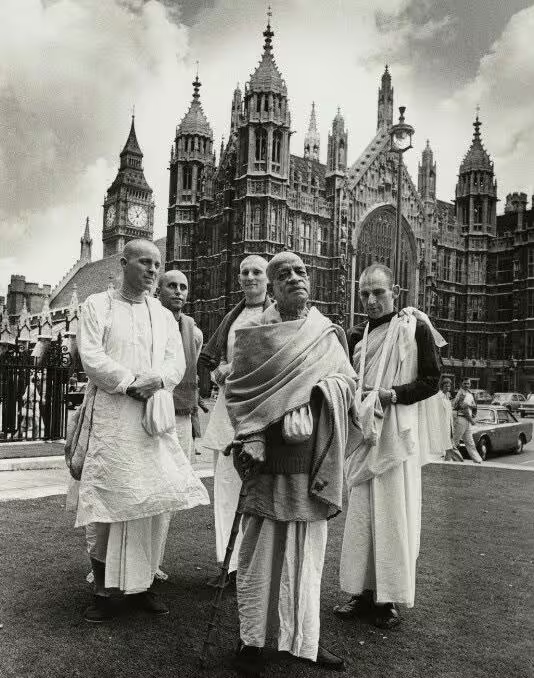
Bhagavad-gītā As It Is
The world’s most widely read edition — over 500 million copies in 75 languages.
Śrīmad-Bhāgavatam
18,000 Sanskrit verses translated with elaborate purports across 12 Cantos.
Caitanya-caritāmṛta
The life and teachings of Śrī Caitanya Mahāprabhu — the golden avatāra of the Kali-yuga.
Continue the Study
Prabhupāda’s books are freely available online. Begin your journey with the Bhagavad-gītā As It Is — widely considered the most faithful and complete translation in any language.